Human in the loop vs. human in the lead: what changes under the EU AI Act

Human in the loop AI has become a familiar model for responsible AI use: let AI perform a task, then involve a person before the result is acted on.
For legal teams, however, the important question is not simply whether a human is somewhere in the process. It is whether that person can understand what the system has done, assess the output against an established standard and intervene when necessary.
Article 14 of the EU AI Act provides a useful framework for thinking about that distinction.
Human in the loop AI: what Article 14 says about human oversight
Article 14 applies to high-risk AI systems. It requires them to be designed and developed so that they can be effectively overseen by natural persons while they are in use.[1]
The requirements go considerably further than adding an approval step after an AI-generated answer. Those responsible for oversight must, as appropriate and proportionate, be able to understand the system’s relevant capabilities and limitations, remain aware of the risk of automation bias, correctly interpret its output, disregard or override that output, and intervene in or interrupt the system.[1]
The underlying point is useful beyond the specific systems classified as high-risk under the Act. Human oversight depends on what the person can actually understand and control, not simply on whether someone clicks approve.
This is particularly relevant to human oversight of AI in legal work, where an output may ultimately affect contractual rights, obligations and risk.
Human in the loop or human in the lead?
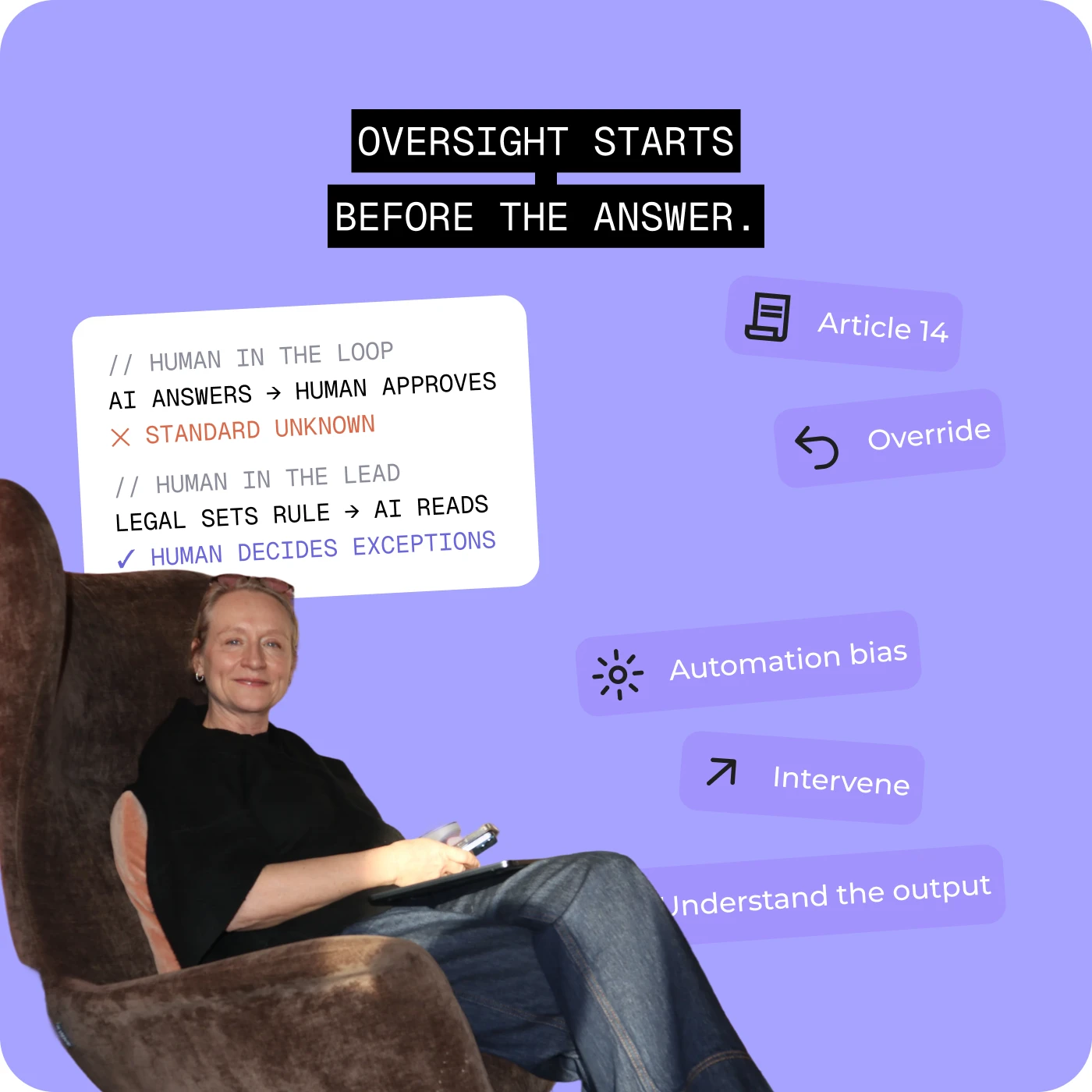
A 2026 Forbes Technology Council article by Vivek Thomas proposes a useful distinction: instead of thinking about people as “human in the loop”, think of them as “human in the lead”.[2]
The phrase does not come from the EU AI Act. Thomas uses it to describe a relationship in which AI extends human judgement rather than replacing it, and the person closest to the decision determines what gets acted on.
Applied to legal work, that distinction raises an important question about where the decision actually sits.
Consider an AI-assisted contract review. An AI system identifies a liability clause as potentially problematic and recommends that a lawyer reject it. The lawyer can accept or reject the recommendation, so there is clearly a human in the loop.
But meaningful oversight depends on more than that final choice. The lawyer still needs to know what standard should apply, why the clause falls outside it and what action is permitted when it does.
If those things are defined before AI produces its recommendation, the relationship changes. The human is not simply reviewing what the AI concluded. Legal has already defined the standard against which the contract should be assessed.
What human in the lead looks like in contract review
This distinction is central to how Lexnus approaches contract review.
Legal first defines and approves the organisation’s playbook: the clauses and rules that represent its legal policy.[3]
When a contract is analysed, AI is used to interpret the document and identify the relevant clauses and information. Those findings are then evaluated against the approved rules. The policy check itself is deterministic: the rule engine, rather than the AI model, determines whether the contract complies or requires human escalation.
For example, Legal might have approved a rule that limits liability to a particular level. AI can identify the liability language and extract the relevant information from an incoming contract. Lexnus then checks that information against the rule Legal has already approved.
If the contract falls outside policy, it can be escalated to a person with the relevant context for a decision.
Human judgement has not disappeared. It is used where it matters: defining the policy and deciding what to do when a contract falls outside it.
Human in the loop asks someone to keep up with the AI. Human in the lead means the AI works inside rules a person already set.
Auditable AI controls are part of human oversight
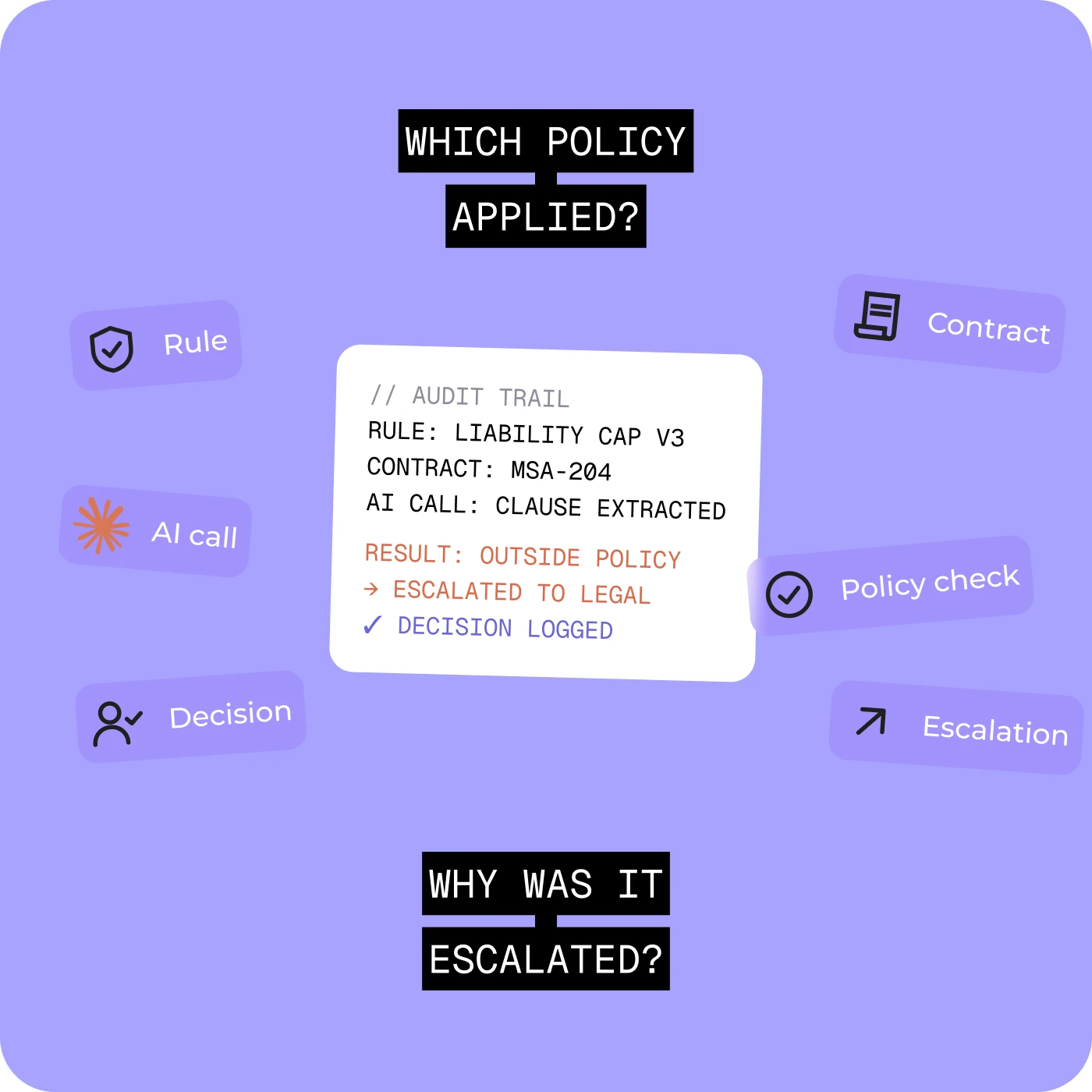
Control also depends on being able to reconstruct what happened.
Lexnus logs the chain behind a policy check, including the rule, the contract, the underlying material, AI calls and the decision. This means the result can be traced back to the policy against which the contract was evaluated.[4]
For a legal team, that makes it possible to answer practical questions later: which policy applied to this contract? What did the system identify? Which rule was applied? Why was the contract escalated?
These auditable AI controls matter because human oversight becomes difficult if the organisation cannot reconstruct how a result was reached.
Human oversight should start before the AI gives an answer
Article 14 does not mean that every AI tool used by a legal team is a high-risk AI system. Nor does it prescribe one particular technical architecture for human oversight.
But it does make the meaning of oversight worth examining.
Adding a person to the end of an AI process is one approach. Giving people the ability to define the rules before the AI is used, understand how those rules were applied and intervene when something falls outside them creates a different form of control.
For legal teams, that distinction will become increasingly important as AI is used across more contract work, including work happening outside Legal’s own systems.
AI can read and interpret the contract. The rules Legal has approved determine whether it complies with policy. Human judgement remains with the people responsible for setting the standard and deciding the exceptions.
Frequently asked questions
What is human in the loop AI?
Human in the loop AI describes a system or process in which a person is involved in reviewing, approving or influencing AI output. The level of human control can vary considerably, which is why the presence of a human alone does not necessarily mean that the person has meaningful oversight of the system.
What does the EU AI Act say about human oversight?
Article 14 requires high-risk AI systems to be designed so that they can be effectively overseen by natural persons during use. Depending on the system and context, this includes being able to understand its capabilities and limitations, recognise automation bias, interpret its output, disregard or override that output, and intervene in the system.
What are auditable AI controls?
Auditable AI controls make it possible to reconstruct how AI was used and how an outcome was reached. In contract review, this can include recording the contract, the policy and rule applied, relevant AI calls, the resulting policy check and any human decision or escalation.
Put your legal policy in the lead
Lexnus turns the legal standards your team has approved into rules that can evaluate contracts consistently. AI interprets the contract; the rule engine determines whether it complies with policy and what needs human escalation.
Sources
- EUR-Lex, Regulation (EU) 2024/1689 (the EU AI Act), Article 14, Human oversight.
- Vivek Thomas, “From ‘Human In The Loop’ To ‘Human In The Lead’: Three Shifts That Change AI Adoption”, Forbes Technology Council, 7 May 2026.
- How Lexnus applies approved rules to contracts: Legal Policy Enforcement.
- What Lexnus records for each analysis: Contract Analysis.
Sources checked on 16 October 2026.